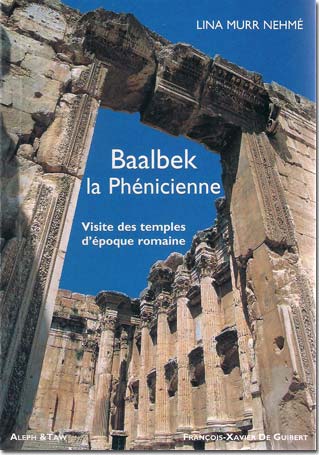
Book Phoenician Baalbek
Price range: $ 11.00 through $ 15.00
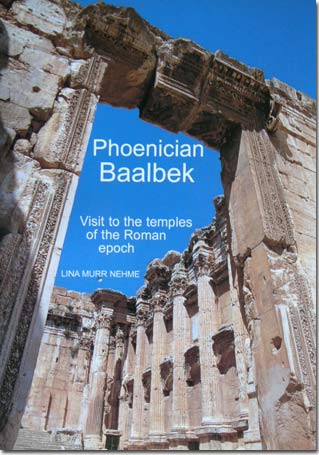
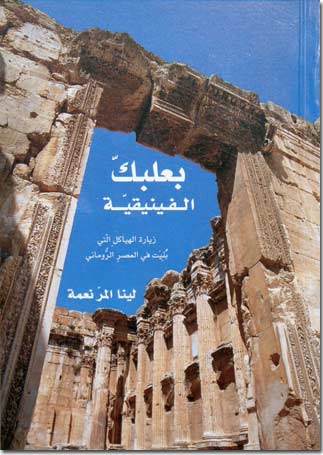
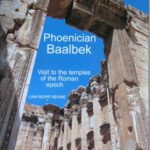
Book of Lina Murr Nehme – ‘Phoenician Baalbek’, ‘A visit to the Temples of the Roman Epoch’ – 16 x 11.4 cm – English, French, and Arabic.

100% Made in Lebanon - صنع في لبنان
- Description
- Shipping & Return
Description
This book of Lina Murr Nehme – ‘Phoenician Baalbek’, ‘A visit to the Temples of the Roman Epoch’, translated by Alfred Murr, is a treasure of Lebanese History!
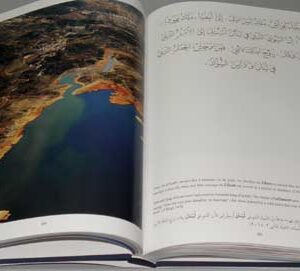
Characteristic of the book: Beirut, Aleph, and Taw – 104 pages with many images and illustrations – 16 x 11.4 cm – English, French and Arabic.
Extracts from the book:
‘Dated graffito proves that the Romans could not have built or financed Baalbek.’
When the peristyle of the sanctuary of Baal was finished, a mason carving the top of one of its columns engraved on it a graffito that began with these words: “To good Fortune! In the year 371, the second day of the month of Lôos (August 60 AD), the katochoi put off their beards”. (Above)
Centuries later, the column that bore this graffito fell off and broke. A fragment containing the writing and a piece of astragal (see glossary) ended up in the sacrificial court of the temple of Baal, where archaeologists found it before World War 2.
Its caliber and astragal shoed that it came from the top of a column belonging to the peristyle of the sanctuary of Baal (see opposite). The ritual it seems to refer to is unknown, but the date implies that the peristyle was finished in the year 60 (in the time of Nero).
Stones, in Baalbek, were carved and dressed from top to bottom, after the end of the construction only. (See the unfinished niche, image page 24).
In this case, the building of the sanctuary could not have begun later than the year 20 B.C.
This discovery turned archaeological beliefs upside down by proving that it was a mistake to attribute this construction to Antoninus Pius (note p. 16), proving also that the Roman emperors neither built nor even financed the greater sanctuary of Baalbek. For if the Roman emperors had had something to do with the construction and financing of Baalbek, they would have been interested in it before, not after, its temples and theatre became famous. And above all (considering the cost of these works and the centuries they have lasted), they would have mentioned it in many texts and inscriptions.
But they became interested in Baalbek only in the second century AD. One of them, Septimus Severus, even gave Baalbek the jus italicus, or status of “Roman” city, making its people Roman citizens.
It was as good a way as any other, to endow Rome with treasures that belonged in fact to the provinces and were impossible to move.
Another way was to call upon Phoenician architects, and have them build in Rome monuments on the scale of those of the Levant. This is what the emperor Trajan, who is considered as the greatest builder among the Roman emperors, did. By taking Apollodorus of Damascus as his architect, he made this Phoenician the Father of Roman architecture – as historians call him.
The financing of Baalbek was, therefore, provided by its worshippers: in three and a half centuries, an internationally frequented religious center like Baalbek attracted enough rich pilgrims to make it very wealthy. (Concerning the nationality of Baalbek, other proofs can be found in Baalbek Monument Phénicien.)
The Religious Complex of Baalbek
In Antiquity, the religious complex of Baalbek consisted of three temples and a theatre.
The peristyle of the sanctuary of the biggest of these temples was, as we said, finished in the year 60. But the general work remained unfinished in 391 (see p. 74), and it still is.
This construction went on, therefore, for more than three centuries and a half, which is far too much for one single temple. This can only be understood if the three temples were being built at the same time.
That is the case. What proves it is, first, the fact that the three temples are in the same state of completion – or incompletion. Second, they were constructed in the same way, their stones cut and dressed in the same way, with the same finish. Finally, they have the same decoration.
No promoter builds three temples of this importance (see following pages) at a time, in order to put the three gods of the city together in one of these temples, while comfortably accommodating one accessory god in each of the two other temples. Rather, he dedicates each temple to one god, seeing that the size and decoration – and the price – of each temple match the supposed importance of this god.
Now, who were these three gods of Baalbek? We often find their portraits in Lebanon (below, relief of Fneidek), and abroad (as far as Rome or Nimes).
Baal, god of the first temple:
The most important god of Baalbek is called Jupiter in Longinus’ inscription… …
Atargatis, goddess of the second temple: etc….
Adonis, god of the third temple: etc…
The twin towers of Baalbek: etc…
The Sacrificial Court or Great court: etc…
The theatre of Baalbek: etc…
The world’s three greatest stones ever built: etc…
Extract French: Baalbek la Phénicienne – Visite des temples d’époques romaine – Lina Murr Nehmé – Aleph et Taw – 15 x 11 cm, 104 pages
Strabon, géographe du Ier siècle:
“Pour ce qui est des Sidoniens [des Phéniciens], l’histoire de tous les temps nous les représente comme un peuple industrieux, un peuple d’artistes — Homère déjà leur donne ce nom —, de philosophes, de savants, puisque, des plus simples notions de calcul et de navigation indispensables au marchand pour naviguer et au marin pour se guider la nuit, ils surent s’élever jusqu’aux abstractions de l’astronomie et de l’arithmétique… On croit généralement que les Grecs ont appris la géométrie des Egyptiens, mais il y a lieu de croire aussi que leurs connaissances en arithmétique et en astronomie leurs sont venues des Phéniciens. Aujourd’hui encore au temps de la construction du grand temple de Baalbek, quiconque veut s’instruire dans les différentes branches de la science trouve à Tyr et Sidon plus de ressources que dans aucune autre ville.”
Auguste Choisy, historien de l’Architecture, XIXe siècle:
“Il ne nous reste sur le sol phénicien que des constructions de pierre ; et ces constructions se distinguent par la masse des blocs mis en œuvre. Les Phéniciens, habitués aux manœuvres de force de la marine, étaient mieux que d’autres préparés à remuer de lourds fardeaux ; aucun peuple n’a construit en blocs plus énormes : les pierres de Baalbek atteignent au poids de 1.000 tonnes.”
H. Kalayan, ingénieur chargé de la restauration de Baalbek, XXème siècle:
“On peut affirmer que Baalbek est un chef d’œuvre de génie et d’outillage libanais, c’est-à-dire une production des habitants du territoire aujourd’hui appelé Liban, un exploit suréminent dans le soulèvement et le transport des blocs cyclopéens, et une œuvre d’art en matière de proportions et de sculpture.”
a. View or Modify What is in Your Shopping Cart.
When in the Shopping Cart area of the site you can view or modify what is in your shopping cart at any time by clicking on the Add More Items/Refresh Totals button along the bottom of your screen.
b. Checking Out and pay for your purchases online.
When you have finished viewing and wish to end your shopping and pay for the items you have selected, click on the Pay & Finish button at the bottom of your screen.
You will be led through a series of secure ordering procedures and will be asked to fill in personal, shipping and payment option information. When this is completed, you will press the Submit Secure Checkout button and your order will be transmitted to LebanonPostcard for fulfillment.
Absolutely not! Right up until the point why you are asked to review the order information you have given us and if it is correct to click on the final Submit Secure Order button, you can abort the order.
If you don't press the Submit Secure Order button then no order information is transmitted to us.
a. Payment by Credit Card
We accept American Express, MasterCard, Visa, Discover, PayPal... etc... for online payments through 2CheckOut.com. Also, arrangements can be made for bank draft and certified check payments by regular post.
b. Payment by Bank Draft and Certified Check
If you would prefer to pay for your purchases by mail, then you have to contact us first so we can give you our account information.
c. We accept as well payment through WesternUnion, RIA, OMT, BOB Finance, Whish Money.
All prices include shipping and handling. LebanonPostcard will be responsible for sending the packages you order, at your charge, through the service D.H.L. / E.M.S. with tracking number code guaranteeing reception of the package.
We ship as soon as possible, but within maximum 4 days after the order is received.
Credit cards are not charged until we actually ship the items. The items may take between one and six days to arrive, according to the country they are sent to.
Packages are sent with track code to guarantee reception, and delay is rare. In the event of non-delivery or delay, nothing can be done for 7 days. At the end of this period, on our being informed, a demand will be made for the package to be traced. If 14 days after the first dispatch there is still no delivery, a second package will be sent free.
Packages inside Lebanon are sent registered through LibanPost to guarantee reception, and delay or non-delivery is rare. In the event of non-delivery, nothing can be done for 6 days. At the end of this period, on our being informed, a demand will be made to LibanPost for the package to be traced. If 12 days after the first dispatch there is still no delivery, a second package will be sent free.
We ship anywhere in the world. Zones and countries we ship to
Yes. You can cancel you order when you receive an email from us confirming your order, you can reply by canceling it.