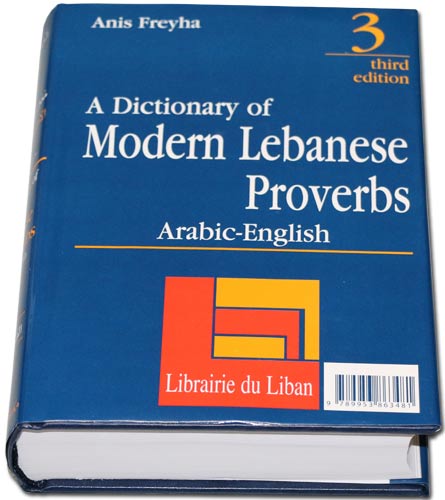
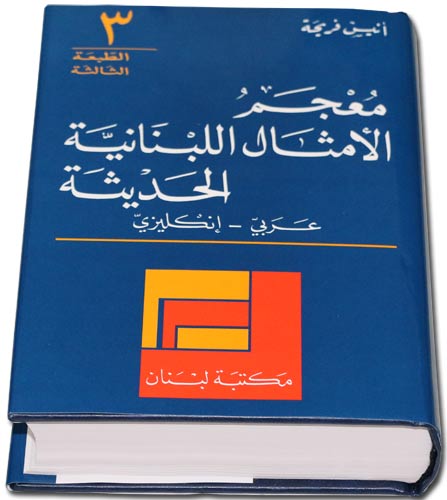
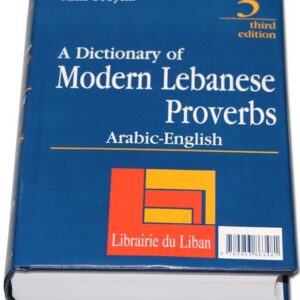
Dictionary of Modern Lebanese Proverbs by Anis Freyha
$ 16.95
A Dictionary of Modern Lebanese Proverbs – Arabic and English by Anis Freyha – Librarie du Liban. 20 x 14.5 x 4 cm – Hardcover, 750 pages – 1kg – Arabic / English.


100% Made in Lebanon - صنع في لبنان
- Description
- Shipping & Return
Description
LebanonPostcard presents the Book: A Dictionary of Modern Lebanese Proverbs – Arabic and English by Anis Freyha – Librairie du Liban.
20 x 14.5 x 4 cm – Hardcover, 750 pages – 1kg – Arabic / English
Preface
This collection was made in Ras Al-Matn, a small village in the district of Matn to the East of Beirut. It is a predominantly Druze village and more and more is becoming a religious center for Druzedom. The primary source from which they were gleaned is the people’s daily conversation. Those who insist, in historic and scientific work, upon documentation and citation will be disappointed in finding nothing of this sort in this work. Nevertheless, we believe that living men and women are the best authentic source for collecting proverbs, determining their true pronunciation and meaning.
At one time I was interested in making a collection of Lebanese folklore, nursery rhymes, popular songs, and superstitions, before they should be lost with the passing of this generation. Ras al-Matn was chosen for this project, not so much because it is my native village as because it is a unique village in a rapidly changing Lebanon. This village has not strongly felt the impact of westernization. Social life, economic life, and Druze religious life goes on uninterrupted in the same manner as they did in the early part of the last century. As I carefully listened to farmers, workers, artisans, and religious chief, I was impressed by their frequent resort to proverbs to substantiate their statements or to enhance their manner of expression. I thought to myself: here is valuable literary material which will also disappear with the passing of this generation unless someone records it. So I began to jot down every proverb I heard. When it was known in the village that I was collecting proverbs, and that I would pay a franc for every new one not found in my already growing collection, people came to me with long lists of proverbs. “And have you heard this one? And have you got this one in your collection?” they said, hoping to get a few francs. This went on until practically no one is Ras al-Matn could add anything new.
At the American University of Beirut, teachers, students, and friends who knew of the project challenged its completeness. So hundreds of proverbs were given to me by Syrians, Palestinians and Iraqi until the collection grew to enormous dimensions. But many were not included in the collection, for I insisted that only those new proverbs known to the people of Ras al-Matn could be added. In Ras al-Matn I had a group of friends and relatives who could tell whether or not the proverb was “Matni” or not. It was meant from the outset, that this collection should be an exhaustive collection of a limited area, not a collection of “Modern Arabic Proverbs”. Such a task is too vast for one individual to undertake. Furthermore, a complete collection of “Modern Arabic Proverbs” could only be done after several such collections of smaller areas were made.
In order to determine to what extent these proverbs from Ras al-Matn are common property to other Arabic speaking countries, I went to the trouble of collating them with other collections made by native and European scholars in Lebanon, Syria, Iraq, Palestine, Egypt, and Transjordan. Mr. Salamah Ubayd, M. A., a former student of mine who comes from Jabal al Druze, Syria, kindly read through the whole collection under instruction to put a cross in red ink on every card containing a proverb which was known to him. It was surprising that practically the whole collection was known to him. It was not so when I asked a girl student from Aleppo to read it. The reason being that the Druzes in both countries, Syria and Lebanon, are one and the same community. Dr. Subhi Mahmassani, a lawyer of Beirut and a lecturer at the A.U.B. placed at my disposal his large collection of Beiruti proverbs (MS). There were many proverbs unknown in Ras al-Matn. Mr Hasan Fariz from Transjordan and a former student of the A.U.B. sent me a very large collection (MS) of proverbs which he himself had collected in his native land. A girl student from Baghdad copied over a thousand from private collections of Iraqi proverbs and sent them to me for collation.
It is safe to state that the common popular one are known throughout the Arabic speaking world, and that the collection made at Ras al-Matn is known practically all over the mountainous section of Lebanon, not the littoral.
In translating these proverbs into English it “was deemed best to give as literal a translation as could be possible provided the translation made sense to a European reader. It was only in a very few cases when the literal translation made no sense that a free rendering of the proverb was given. The italic words in brackets refer to the implied words which do not appear in the Arabic text.
It would have been desirable to give a transliteration of the Arabic for the sake of dialectology. But with the printing facilities we have, it was impossible to do so. The Arabic text is richly vocalized, but students of Arabic know well that the Arabic script is deficient and cannot reproduce the true pronunciation. Also, it would have been desirable to tell in detail how and when each proverb is used by giving examples. Such an attempt would have made this work voluminous.
We must apologize to the reader for the inclusion of objectionable proverbs. But in a collection of proverbs which claims completeness, and for the sake of sociological and psychological studies, it was deemed necessary to include the “smutty” ones.
I am indebted to Mrs. Robert C. Byerly of the American Presbyterian Mission, and to Professor Byron Smith, head of the English Department at the A.U.B. for reading the English translation. Professor Smith’s long residence in Lebanon and his knowledge of its spoken Arabic give weight to the valuable remarks he made which were incorporated in the translation.
Anis Frayha – 1953
LebanonPostcard will be responsible for sending the book you order, through fast courier with a track number, guaranteeing reception of the package.
The book may take between two and five days to arrive, according to the country it is sent to.
a. View or Modify What is in Your Shopping Cart.
When in the Shopping Cart area of the site you can view or modify what is in your shopping cart at any time by clicking on the Add More Items/Refresh Totals button along the bottom of your screen.
b. Checking Out and pay for your purchases online.
When you have finished viewing and wish to end your shopping and pay for the items you have selected, click on the Pay & Finish button at the bottom of your screen.
You will be led through a series of secure ordering procedures and will be asked to fill in personal, shipping and payment option information. When this is completed, you will press the Submit Secure Checkout button and your order will be transmitted to LebanonPostcard for fulfillment.
Absolutely not! Right up until the point why you are asked to review the order information you have given us and if it is correct to click on the final Submit Secure Order button, you can abort the order.
If you don't press the Submit Secure Order button then no order information is transmitted to us.
a. Payment by Credit Card
We accept American Express, MasterCard, Visa, Discover, PayPal... etc... for online payments through 2CheckOut.com. Also, arrangements can be made for bank draft and certified check payments by regular post.
b. Payment by Bank Draft and Certified Check
If you would prefer to pay for your purchases by mail, then you have to contact us first so we can give you our account information.
c. We accept as well payment through WesternUnion, RIA, OMT, BOB Finance, Whish Money.
All prices include shipping and handling. LebanonPostcard will be responsible for sending the packages you order, at your charge, through the service D.H.L. / E.M.S. with tracking number code guaranteeing reception of the package.
We ship as soon as possible, but within maximum 4 days after the order is received.
Credit cards are not charged until we actually ship the items. The items may take between one and six days to arrive, according to the country they are sent to.
Packages are sent with track code to guarantee reception, and delay is rare. In the event of non-delivery or delay, nothing can be done for 7 days. At the end of this period, on our being informed, a demand will be made for the package to be traced. If 14 days after the first dispatch there is still no delivery, a second package will be sent free.
Packages inside Lebanon are sent registered through LibanPost to guarantee reception, and delay or non-delivery is rare. In the event of non-delivery, nothing can be done for 6 days. At the end of this period, on our being informed, a demand will be made to LibanPost for the package to be traced. If 12 days after the first dispatch there is still no delivery, a second package will be sent free.
We ship anywhere in the world. Zones and countries we ship to
Yes. You can cancel you order when you receive an email from us confirming your order, you can reply by canceling it.