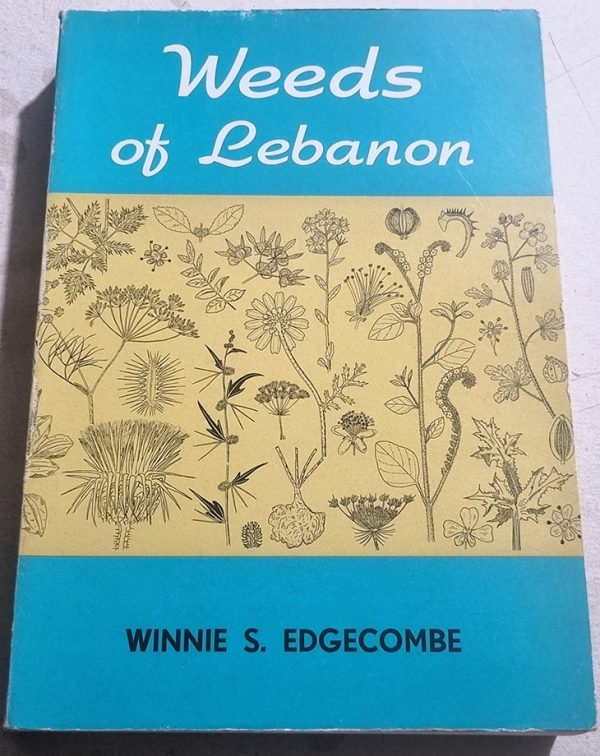
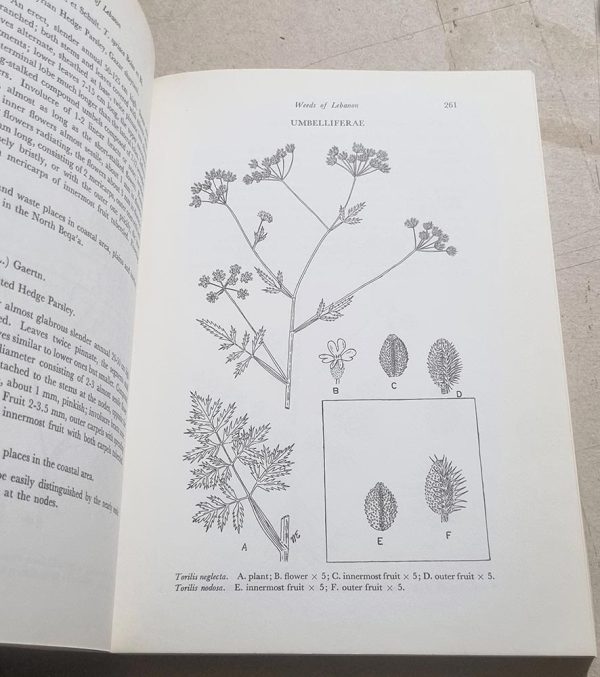
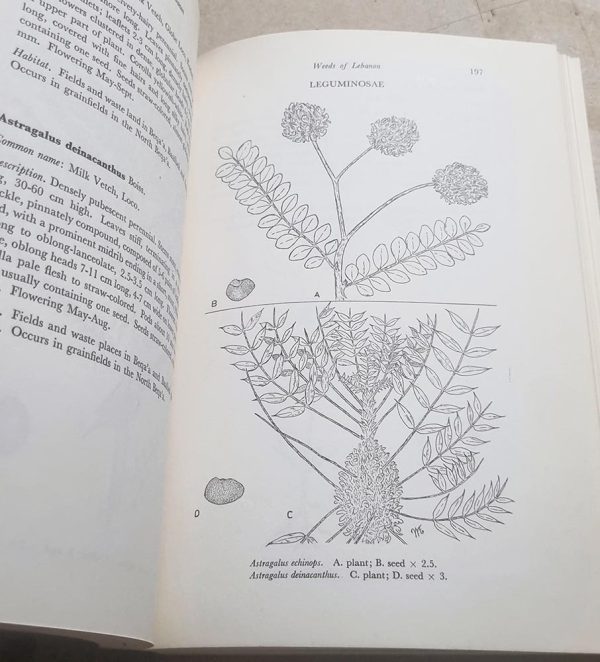

Weeds of Lebanon, Winnie S. Edgecombe
$ 125.00
Weeds of Lebanon, Winnie S. Edgecombe, third edition, revised and enlarged, illustrations by the author.


100% Made in Lebanon - صنع في لبنان
- Description
- Shipping & Return
Description
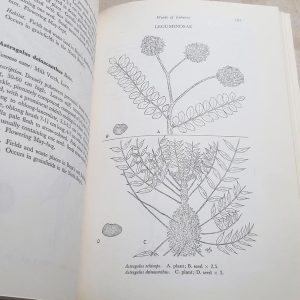
LebanonPostcard presents a unique book, Weeds of Lebanon, Winnie S. Edgecombe, third edition, revised and enlarged, illustrations by the author, American University of Beirut, Lebanon 1970 – Softcover book, 24×17 cm, 458 pages
INTRODUCTION
THE FIRST EDITION of this book was published in Beirut in 1959 under the title “Some Major Weeds Of The North Beka’a.” A total of 91 species belonging to 23 families was described in the
text. The 67 plates included complete or partial drawings of 88 species. The second illustrated book on weeds of Lebanon was published in Beirut in 1964 under the title “Weeds Of Lebanon.” A
total of 130 species belonging to 32 families were described in the text. The 98 plates included complete or partial drawings of 125 species.
A nation-wide survey of weedy plants in Lebanon has shown that there are other important species not included in the first two books. These species have been described and illustrated and are
now combined with the material in the two previous books. A total of 341 species belonging to 46 families is described in the text. The 214 plates include complete or partial drawings of 318 species.
Scientific names are used throughout the text supplemented with common English and Arabic names whenever possible. A knowledge of plant names is necessary for anyone initiating a weed control program, or wishing to identify the common plants of the area. In order to identify specific insect pests or pathogens causing plant disease one must know the scientific name of the host plant. This book is designed to make it possible to determine the name of a plant by comparing it with illustrations and descriptions in the text.
Botanical Terms
A simplified version of botanical terms is used in the text. The terms are used as defined in the glossary and explained by the drawings and the text.
A simple complete flower is composed of sepals, petals, stamens and pistil. The sepals are leaf-like structures constituting the calyx which is found on the outside of the flower. The petals are usually showy, often colored, located adjacent to the calyx and are referred to collectively as the corolla. The calyx and corolla together are referred to as the floral envelope or perianth and protect the sex organs in the inner part of the flower. The stamens are the pollenbearing organs and are found within the petals. The pistil is usually in the center of the flower, surrounded and protected by the other floral parts. It often has a bulbous base, the ovary, containing the ovules, and a slender stalk leading up from the ovary called the style. The tip of the style is known as the stigma.
Leaves may be simple or compound. If they are compound the divisions are referred to as leaflets; these leaflets may be pinnate (feather-like) or palmate (finger-like). If the leaf has a stem it is
referred to as being stalked or having a petiole; if it has no stalk the leaf is sessile.
Types of Weeds
Many definitions have been given for a weed but primarily it is a plant that has not been sown by man and is not wanted. Weeds are classified into 3 main groups according to their period of growth.
ANNUALS
Annuals complete their life cycle within one year or one season, during which they produce seed and die. They depend entirely upon seed for reproduction.
Summer annuals germinate in the spring and mature and produce seed during the summer. They die in the summer or fall.
Winter annuals germinate in the fall or winter. They usually form a rosette of leaves and live through the winter in a vegetative stage. In the late winter or early spring they grow rapidly, mature
and produce seeds.
BIENNIALS
Biennials require two growing seasons to complete their life cycle, passing the first year in the vegetative stage and flowering and producing seeds the second summer. This group depends upon seed for reproduction.
PERENNIALS
Perennials live for three or more years and reproduce both by seed and vegetative means.
Simple perennials have either fibrous roots or fleshy taproots and depend largely upon seed for reproduction. However, if the roots or crowns are broken during cultivation, broken pieces are
capable of producing new plants.
Creeping perennials reproduce both by seed and by creeping stems. These creeping stems are of two types, rhizomes and stolons. Rhizomes are colorless stems arising at the base of the main stem under the ground, spreading out horizontally and sending up young plants at a distance from the parent plant. Stolons are green stems arising at the base of the main stem and lying on the surface of the earth instead of beneath it, producing new plants and roots at the nodes. These weeds are among the most difficult to control. Bermuda grass is a valuable lawn grass but because it spreads by seeds, stolons and rhizomes it becomes a noxious weed when it occurs in crops.
Bulbous perennials reproduce by seeds, bulbs, bulblets and tubers. Numerous bulbous plants are found in crops in Lebanon but with the exception of Cyperus rotundus and Oxalis cernua, they are usually not agressive enough to become a serious problem. Two examples are Ixilirion tataricum and Gladiolus aleppicus which are conspicuous in grain fields because of their colorful flowers.
Characteristics of Harmful Weeds
The following characteristics are common features of harmful weeds.
Dormancy of seed. In some species seed germination may be delayed for years permitting viable seed to be scattered by wind, animals, water and man over a long period of time. Some may remain buried in the soil for a long time and then germinate when conditions become favorable.
Amount of seed. Many of the weeds produce hundreds and thousands of seeds. Some of these seeds are easily scattered either because their size is similar to that of the crops in which they grow or because they have barbs or light tufts of hair, or because they are almost microscopic in size.
Adaptation to climate. Many weeds are adapted to adverse conditions and can survive droughts, floods or other climatic conditions which are too severe for crop plants.
Resistance to grazing animals. Many weeds have sharp spines which make them unattractive even to goats and camels. Others have a disagreeable odor or taste and are avoided by animals whenever possible. By mid-summer the Lebanese countryside is covered with spiny, prickly plants when all other vegetation has been consumed by goats.
Losses due to Weeds
Weeds cause reduced crop yields due to competition for water, light and nutrients. Since water is limited in most of Lebanon, a grower cannot afford to have a high concentration of weeds whose water requirements are as much or more than that of the crop plants. In the Middle East this waste of available water is a serious problem.
Competition for light may be disastrous in the seedling stage since many young plants are smothered by the faster growing weeds.
If weeds are allowed to compete with crops for nutrients, there is an outlay of capital for fertilizer for which no return can be expected.
Weeds may provide a place for harmful insects to over winter or serve as hosts for pathogens. Even though crops may be sprayed for insects and diseases they may be reinfected from the contaminated weeds.
Certain weed seeds, if harvested with the crop affect the quality of the final product. If Cephalaria syriaca or Lolium temulentum are found in any quantity in wheat they will give an undesirable odor and color to the flour.
Plant parasites such as Orobanche draw their food directly from the host thus greatly reducing the yield and at times destroying the entire crop.
LebanonPostcard will be responsible for sending the book you order, through a fast courier with a tracking number, guaranteeing reception of the package. The souvenirs may take three to five days to arrive, according to the country they are sent to.
a. View or Modify What is in Your Shopping Cart.
When in the Shopping Cart area of the site you can view or modify what is in your shopping cart at any time by clicking on the Add More Items/Refresh Totals button along the bottom of your screen.
b. Checking Out and pay for your purchases online.
When you have finished viewing and wish to end your shopping and pay for the items you have selected, click on the Pay & Finish button at the bottom of your screen.
You will be led through a series of secure ordering procedures and will be asked to fill in personal, shipping and payment option information. When this is completed, you will press the Submit Secure Checkout button and your order will be transmitted to LebanonPostcard for fulfillment.
Absolutely not! Right up until the point why you are asked to review the order information you have given us and if it is correct to click on the final Submit Secure Order button, you can abort the order.
If you don't press the Submit Secure Order button then no order information is transmitted to us.
a. Payment by Credit Card
We accept American Express, MasterCard, Visa, Discover, PayPal... etc... for online payments through 2CheckOut.com. Also, arrangements can be made for bank draft and certified check payments by regular post.
b. Payment by Bank Draft and Certified Check
If you would prefer to pay for your purchases by mail, then you have to contact us first so we can give you our account information.
c. We accept as well payment through WesternUnion, RIA, OMT, BOB Finance, Whish Money.
All prices include shipping and handling. LebanonPostcard will be responsible for sending the packages you order, at your charge, through the service D.H.L. / E.M.S. with tracking number code guaranteeing reception of the package.
We ship as soon as possible, but within maximum 4 days after the order is received.
Credit cards are not charged until we actually ship the items. The items may take between one and six days to arrive, according to the country they are sent to.
Packages are sent with track code to guarantee reception, and delay is rare. In the event of non-delivery or delay, nothing can be done for 7 days. At the end of this period, on our being informed, a demand will be made for the package to be traced. If 14 days after the first dispatch there is still no delivery, a second package will be sent free.
Packages inside Lebanon are sent registered through LibanPost to guarantee reception, and delay or non-delivery is rare. In the event of non-delivery, nothing can be done for 6 days. At the end of this period, on our being informed, a demand will be made to LibanPost for the package to be traced. If 12 days after the first dispatch there is still no delivery, a second package will be sent free.
We ship anywhere in the world. Zones and countries we ship to
Yes. You can cancel you order when you receive an email from us confirming your order, you can reply by canceling it.